Powering Up Your Thinking on Migration: 7 Essential Reads from EU Migration Scholars
Earlier this month I had the opportunity to participate in the conference Polish Migration Law in Times of Change – Law as an Instrument of Protection, Control and Sanction, organised by the Institute of Law Studies of the Polish Academy of Sciences. Over two days, scholars and practitioners discussed how migration law in Poland and across Europe is evolving in response to political pressures, security concerns, and ongoing political tensions. The talks and lectures addressed topics such as the future of EU return policy, the relationship between border control and migration governance, and the increasing role of emergency legal frameworks in shaping migration policy.
Together with Zuzanna Filipowicz and Anna Szachoń-Pszenny, I also took part in what may have been one of the first conference panels in Poland explicitly focusing on the instrumentalisation of law in migration governance. The discussion brought together researchers examining how legal frameworks can be used not only to regulate migration, but also as tools within broader political and strategic dynamics.
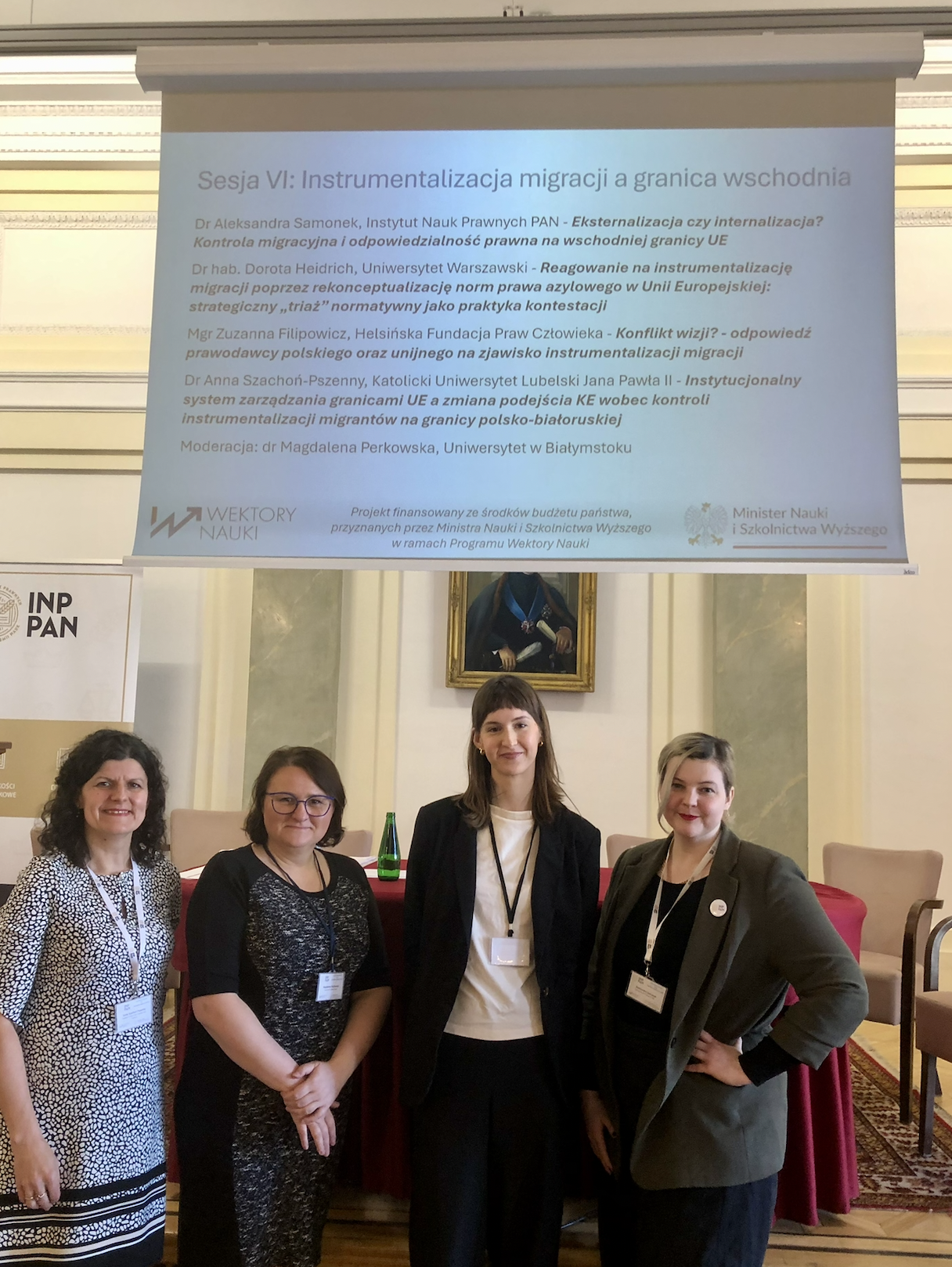
Many thoughtful reflections from the conference have already been shared online. Among them were posts by Kamil Kaplan and Katarzyna Strąk, who was also part of the organising committee together with Monika Szulecka, Witold Klaus, Izabela Florczak, Maja Lysienia, Joanna Markiewicz-Stanny, and Magdalena Perkowska. (See posts here and here).
The event also featured a wide range of speakers and panel participants working on migration governance and border control, including, among others Agnieszka Narożniak, Justyna Nakonieczna-Bartosiewicz, Margarita Dylewska, Hubert Zapolski, and Katarzyna Tarczyńska, as well as colleagues from the Institute such as Tomasz Kosicki and Joanna Grygiel-Zasada.
Rather than attempting to summarise all the discussions — which would hardly do justice to the richness of the debates — I thought I would share something different: a reading list inspired by conversations and recommendations made during the conference. The books and reports below are not meant to be exhaustive, rather, they reflect readings that have influenced my own thinking about migration, asylum, borders, and the role of law. Perhaps you will find something here worth adding to your own reading list.
Policing Humanitarianism by Sergio Carrera, Valsamis Mitsilegas, Jennifer Allsopp, Lina Vosyliute
This book examines how EU policies designed to combat migrant smuggling increasingly affect civil society organisations providing humanitarian assistance to migrants. It explores the tension between migration control and humanitarian action — a dynamic visible across Europe, where NGOs, volunteers, and activists sometimes face legal risks for assisting migrants. For anyone interested in the legal boundaries between solidarity and criminalisation, this is essential reading. (Read more)
State of Exception by Giorgio Agamben
Although not written specifically about migration, Agamben’s work has become highly influential in migration and border studies. His concept of the state of exception describes how emergency powers — initially justified as temporary responses to crises — can gradually become normalised within legal systems. This framework is often used to analyse emergency measures in migration governance, particularly in border regions. (Read more here and here)
I-CLAIM Project Reports
The I-CLAIM research project examines the living and working conditions of migrants with precarious legal status in Europe. The project combines academic research with collaboration with labour unions, NGOs, and policymakers. Its work covers several countries, including Finland, Germany, Italy, Poland, the Netherlands, and the United Kingdom, and offers important insights into how legal status shapes access to labour rights, housing, and social protection. (i-claim.eu)
Weapons of Mass Migration by Kelly M. Greenhill
Kelly Greenhill’s research explores how forced migration can be used as a tool of political pressure. Her framework has been widely discussed in relation to the Belarus–Poland border situation, where migration flows have been described by some analysts as a form of strategic coercion. Whether one agrees with this perspective or not, Greenhill’s work has significantly shaped debates on instrumentalised migration. (Read more)
The Utopia of Rules by David Graeber
Anthropologist David Graeber’s reflections on bureaucracy offer surprisingly relevant insights for those studying migration governance. His work highlights how bureaucratic systems expand, reproduce themselves, and sometimes generate complex administrative structures that shape people’s lives in profound ways. Anyone researching asylum procedures, migration administration, or visa regimes may recognise many of the dynamics Graeber describes. (Read more)
Inside Asylum Appeals: Access, Participation and Procedure in Europe by Nick Gill, Nicole Hoellerer, Jessica Hambly, Daniel Fisher
This recent book provides a detailed examination of how asylum appeals function in practice across Europe. Rather than focusing only on legal doctrine, it explores how procedural rights operate in real decision-making contexts — including access to legal representation, participation in hearings, and the institutional dynamics that shape appeal procedures. (Read more)
Political Justice by Otto Kirchheimer
Kirchheimer’s classic study examines how legal processes can become instruments of political power. Although originally written about political trials, revisiting the book today through the lens of migration and asylum law raises fascinating questions about how legal procedures can serve symbolic, strategic, or political purposes beyond their formal legal role. (Read more)
Understanding migration governance requires moving between these perspectives. Legal texts alone rarely capture the full complexity of how migration systems actually function. Reading across disciplines helps illuminate how law, institutions, political narratives, and human experiences intersect at borders. I would be very curious to hear additional recommendations — the reading list is always unfinished.
What books or articles have shaped your thinking on migration or asylum law?